
Preface:
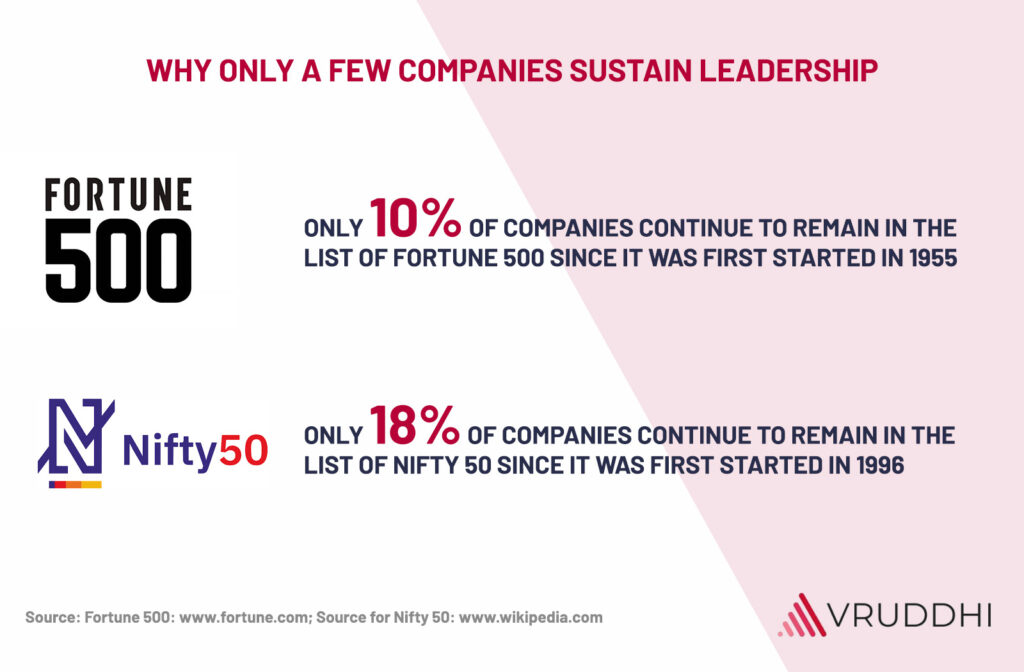
The adage, “out with the old, in with the new” is a poignant reminder of the accelerating pace of change that businesses are experiencing. Perhaps this data is a reminder of how brutal the marketplace is. And yet, the silver lining is that there are companies that are able to overcome the barriers of market forces and remain relevant and market competitive over significant periods of time.
The obvious question is what really explains such dominance over periods of time. While the literature is full of business-related factors such as Innovation and R&D, Customer Centricity, Operational excellence, Technology, Financial excellence and so on, I thought it would be interesting to share some of the less spoken about factors that really underpin this success.
“Market leadership is not just about the strategies you implement but the mindset and behaviors you cultivate. A visionary leader who fosters a culture of continuous learning, innovation, and resilience can guide their organization to sustained success, adapting and thriving through every market shift.”
1. Overcoming limiting beliefs and embracing a growth mindset
Leaders generally do a pretty good job when the macro environment is relatively stable. The businesses they are leading have adapted well to the conditions and have reached a state of productive equilibrium. Changes and adaptations are more incremental and less threatening.
However there comes a time when there is a shift in the macro environment due to innovations that’s taking place in the external environment. It is during these times that leaders are most susceptible to their limiting beliefs and what led them to success in the past. This is due to several cognitive and psychological factors such as fear of failure, comfort with status quo, or simply organizational inertia. Overcoming these beliefs requires self-awareness, openness to new ideas, and a commitment to fostering a culture of change.
2. Elephants in the room are named and discussed
“Elephants in the room” refer to obvious problems or issues that are being ignored or avoided in discussions, particularly in leadership teams. In highly adaptive organisations, no questions are off-limits. There is a culture of psychological safety that allows for someone to ask that hard question, or raise a difficult issue even if the issue makes them or others in the room squirm with discomfort.
To that same spirit, the leader might ask the question like “what are we missing?” or “is there an angle we haven’t discussed yet?”. Leadership is about asking / encouraging those hard questions that really help organisations remain adaptive to change.
3. Shared responsibility for the organization’s future
Organisations create boundary lines to demarcate clear roles and responsibilities. However, as we have often observed, these boundary lines can also create an orientation to protect and grow one’s turf, and limit the ability to operate seamlessly across boundaries as needed to adapt to change.
In an organisation with a high capacity to adapt, leaders collaborate across boundaries and share responsibility for the organization’s future. When leadership is aligned, the team below them are automatically aligned to the collective outcome.
4. Reflection and continuous learning
As people move up the hierarchy in any organisation, it becomes increasingly difficult to acknowledge that they don’t have all the answers. Being open to learning is a critical capacity for anyone seeking to enable their organisations to adapt.
By practicing a culture of reflection, we are constantly creating loops of learning that enable an organisation to stay agile, innovate and remain competitive in dynamic environments.
One of the examples here is the “fail fast, learn fast” mindset. As teams develop a culture of reflection, they can quickly learn from failures and iterate on their ideas thereby being more likely to achieve market-leading innovations.
“Mindset plays a crucial role in shaping a company’s culture, strategy, and overall approach to maintaining market leadership.”
Conclusion:
When you look at the companies that have sustained market leadership over time, look no further than the leadership at the helm of these companies Growth is a mindset.
Growth has to be manifested in the mind of the leader before it can manifest across the organisation. The collective mindset and behaviors of the leader and the leadership team profoundly influences its ability to create and sustain market leadership.